
Not Every Workplace Problem Needs an Investigation
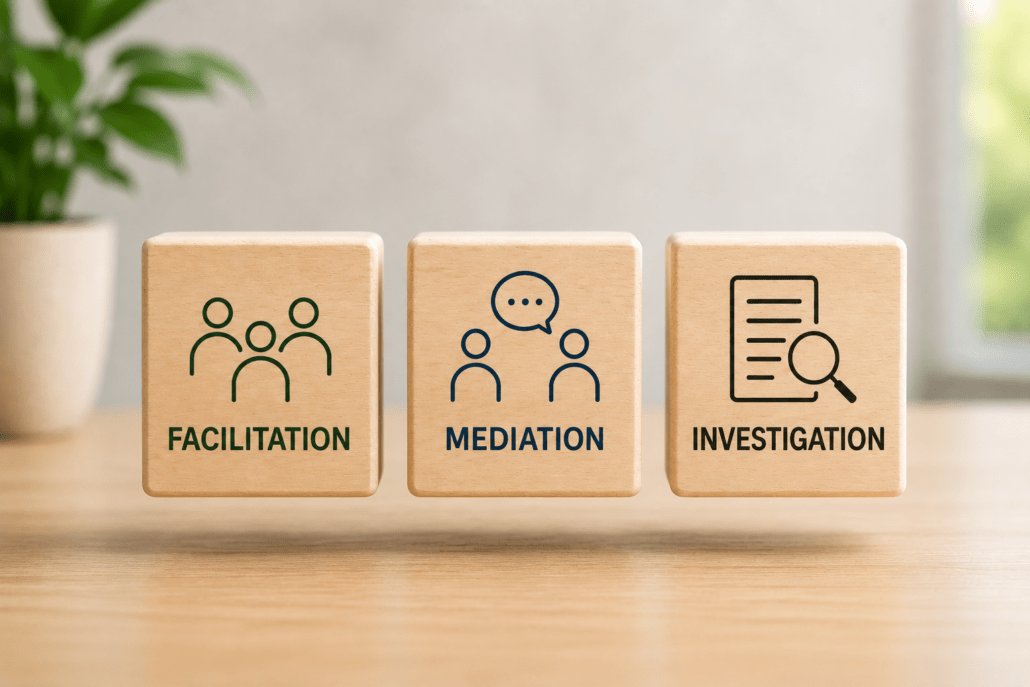
“We know we need to do something. We just don’t know whether that something is an investigation, mediation, or facilitation.”
That’s one of the most common things I hear from clients. And honestly, it’s one of the most important questions to get right.
A team has fractured. Complaints have landed. People are copying the whole office into emails that should have been a conversation. HR is already involved, and nobody seems to agree on what should happen next.
I’ve seen organisations jump straight to an investigation when what they actually needed was a facilitated conversation. I’ve also seen organisations try to mediate a situation that needed formal findings first. Both mistakes are expensive. Not just financially, but in trust, time and people walking out the door.
So here’s how I think about it.
There’s no hierarchy between these processes. An investigation isn’t “more serious” than mediation, and facilitation isn’t a softer option. They’re different interventions designed to solve different problems. The key is diagnosing the problem before deciding on the solution.
Team Facilitation: When the Whole Team Is the Problem
Picture this. A team has fractured. Complaints are flying in multiple directions. Meetings are tense. People are taking sides. HR has spoken to everyone, and everyone has a different version of what’s happening.
This is where facilitation usually fits.
A facilitated process isn’t about determining who’s right and who’s wrong. It’s about getting the whole group into a room and having a structured conversation about what’s actually happening, what’s driving the conflict, and what needs to change.
What I often find is that the presenting issue isn’t the real issue. People come in angry at a colleague, but what’s actually fuelling the conflict is unclear reporting lines, inconsistent decision-making, or a process that forces people to compete for resources they should be sharing. The interpersonal stuff is real, but it’s a symptom.
Fix the structure and a lot of the friction disappears.
Facilitation works when the team is still willing to engage. It doesn’t require anyone to admit fault. It does require everyone to show up, be honest, and commit to doing something different.
The mistake I see most often: organisations waiting too long. By the time they call me, the conflict has been festering for months. Facilitation works best when you act early, before positions harden and before people start lawyering up.
Mediation: When Two People Need to Sort It Out
Sometimes the conflict isn’t a team issue. It’s between two people. They used to work well together but something happened, and now the relationship has broken down. They communicate by email only. Their teams have started taking sides. The tension is affecting everyone around them.
This is where mediation is often the right intervention.
Mediation is a structured, confidential process where two people sit down with an independent mediator and try to find a way forward. Nobody makes findings. Nobody decides who’s right. The participants stay in control of the outcome, and any agreement is voluntary.
It works when both people are willing to participate, when there are no serious allegations that need formal findings, and when the goal is to repair (or at least manage) the working relationship rather than determine fault.
The mistake I see most often: using mediation when there’s a power imbalance that hasn’t been addressed. If one person has significantly more power than the other, whether through seniority, personality, or simply being louder, mediation can feel unsafe for the less powerful person. That doesn’t mean it can’t work, but it means the mediator needs to recognise the imbalance and manage it carefully.
Investigation: When You Need to Know What Happened
Now a different situation entirely. An employee has made a formal complaint alleging bullying by their manager. The allegations are specific: public humiliation in team meetings, unreasonable workload, being excluded from decision-making. The employee has been on stress leave for two weeks.
You can’t mediate this.
You can’t facilitate your way through it.
You need to find out what happened.
A workplace investigation is a formal, evidence-based process. The investigator interviews the parties and any witnesses, reviews documents and records, assesses credibility where accounts conflict, and makes factual findings. The organisation then uses those findings to decide what action to take.
Investigations are necessary when the organisation needs to determine facts, when there are allegations of misconduct, bullying, harassment or discrimination, or when the outcome could involve disciplinary action.
The mistake I see most often: not investigating at all. I cannot count the number of times I’ve been called in after an organisation tried to “handle it informally” and the situation got worse. If someone has made a formal complaint with specific allegations, informal chats and hoping it goes away isn’t a strategy. It’s a liability. The recent Hawkesbury Race Club case, where the Federal Court awarded $2.8 million after an employer failed to investigate a bullying complaint, is a reminder of where that ends up.
Sometimes It’s Not Either/Or
Here’s what most articles about this topic won’t tell you: these processes are often sequential, not competing.
I regularly get called in to facilitate a team after an investigation has concluded. The investigation establishes the facts and deals with the conduct issue. The facilitation helps the team pick up the pieces and figure out how to work together going forward.
These processes aren’t competing options. They’re different tools that solve different problems. Sometimes an organisation needs more than one.
So Which One Do You Need?
Ask yourself one question: what is the organisation trying to achieve?
If you need findings, you need an investigation.
If two people need help repairing a working relationship, mediation is likely the right starting point.
If a whole team is struggling with communication, trust, or the way work is structured, facilitation is often the most effective place to start.
And if you’re not sure? That’s a conversation worth having with someone who does this work, before the situation escalates and your options narrow.
The biggest mistake organisations make isn’t choosing the wrong process. It’s assuming they already know what the problem is.
Get the diagnosis right, and the solution usually becomes much clearer.
If you’d like to talk through your situation, I’d be happy to help.
Saranne Segal
Director, Segal Conflict Solutions
Workplace Investigator | Mediator | Facilitator


