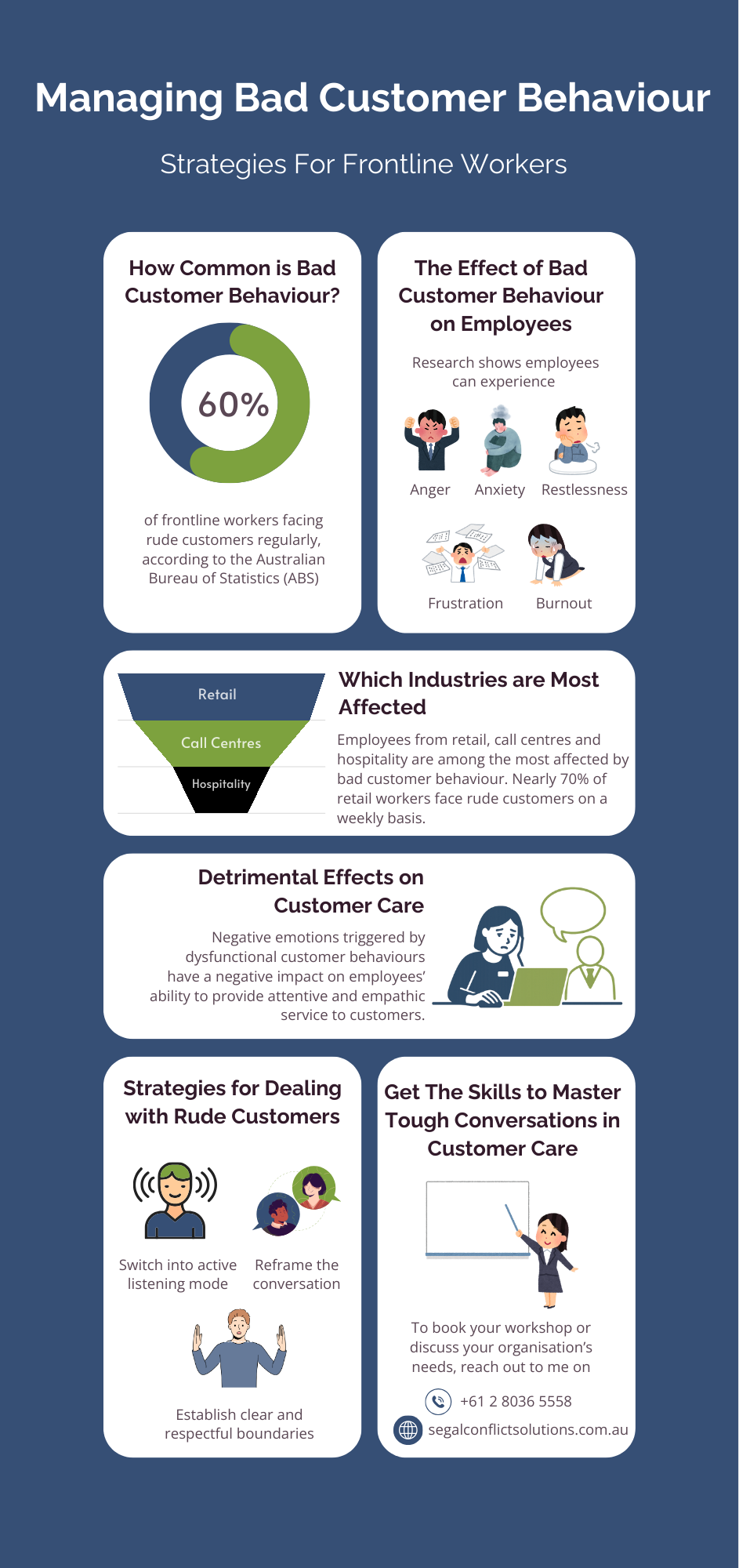
Knowing how and when to have a difficult conversation is a vital skill for anyone in a workplace and is one of the key pillars of conflict resolution. The need to have a difficult conversation can arise for various reasons. A difference in values or perspectives, unmet performance targets, or disrespectful behaviour will, at some point, need to be addressed.

Here are some familiar scenarios I regularly encounter in my work as a conflict resolution specialist.

Approaching Someone About Their Poor Performance
Matt has been dropping the ball at work for several months. While he still shows up every day on time, he’s often not really present and seems distracted most of the time. His colleagues have been picking up the slack, but they’ve started to complain to their manager, Sam. Sam has noticed the changes as well and decided to have a conversation with Sam about it.

  1. Preparation
    Sam gathers facts, data and concrete examples illustrating Matt’s poor performance. This includes specific projects or tasks where timelines were missed and emails illustrating when Matt said he would do something and then didn’t follow through.
  2. Choosing the right time and place
    Knowing a difficult conversation should never come from a place of anger, Sam chooses a time and date in the near future for a private meeting. They book a quiet meeting room that makes it easier to have an open and honest conversation.
  3. Starting with a positive
    Sam starts the conversation by acknowledging Matt’s strengths; how even though they can see it’s been a struggle, Matt has continued to show up day after day, which shows commitment.
  4. Using the right language
    Sam ensures they use “I” statements to express their concerns about the observed decline in performance.
  5. Being specific and objective
    When providing examples to Matt, Sam focuses on the behaviour, not Matt’s personal traits.
  6. Listen to their perspective
    Sam leaves plenty of time for Matt to give their perspective on the change in behaviour and performance. This gives Sam insights into the challenges Matt has had.
  7. Identifying root causes
    Together, they can identify the root cause of Matt’s performance issues. His partner has been diagnosed with an illness that requires intensive treatment, coupled with a change in process at work that has meant Matt needs to do additional tasks he doesn’t have time for.
  8. Set clear expectations
    Sam and Matt discuss specific steps they will take to address the performance issues. Matt agrees to take a day-a-week carer’s leave to support his partner, and Sam will investigate the change in process to see how that can be better managed.
  9. Follow-up and monitor progress
    Sam puts a fortnightly catch-up in the diary so they can check in and ensure the steps they’ve agreed upon are working.

Approaching Someone About Their Disrespectful Treatment of You
Brooke’s co-worker, Helen, continually talks over her in meetings. Whether it’s just the two of them, or a broader team meeting, if Brooke says something, Helen cannot help but interrupt her. It’s been happening for several months, and other colleagues have commented on it to Brooke. She decides to speak to Helen about it.

  1. Preparation
    Brooke gathers examples of when Helen acted disrespectfully. This includes specific meetings and what was said.
  2. Choosing the right time and place
    Brooke asks Helen if they can chat privately. She books a room away from their colleagues’ eyes and ears.
  3. Starting with a positive
    Brooke begins by talking about the positives of their working relationship.
  4. Using the right language
    She uses “I” statements to express her concerns.
  5. Being specific and objective
    When providing examples to Helen, Brooke focuses on the behaviour, not Helen’s personal traits. She communicates the impact the constant interrupting is having on her mental health and well-being.
  6. Listen to their perspective
    Brooke gives Helen the opportunity to respond. Helen says she was unaware she was doing it but can see from the examples that she is indeed interrupting her constantly. She says she feels terrible about it.
  7. Setting boundaries and expectations
    Brooke says she appreciates Helen’s response and hopes they can have a more positive working relationship going forward. Had Helen responded defensively, Brooke would have highlighted the consequences of the behaviour continuing and communicated that she may have to lodge a complaint if the behaviour doesn’t stop or she would ask for a neutral third party to mediate.

I cover this and more in my highly popular workshop, Manage Difficult Conversations and Communicate Better. Everyone can benefit from improving their communication skills—it leads to a happier, more harmonious workplace.

To book your workshop or discuss your organisation’s needs, reach out to me on 02 8036 5558 or email saranne@segalconflictsolutions.com.au


As we bid farewell to 2023, workplaces are navigating a path forward, defining their future. In many ways, it’s been another year of workplaces finding their feet. Some continue to embrace the lessons and ways of working developed during the pandemic, while others are rolling back certain freedoms. As we head into 2024, I share my five predictions that will impact workplace culture. Join us in exploring five key trends for 2024 that will reshape the landscape of workplace culture.

  1. An increased risk of industrial action and employee activism For a while there, employees had the upper hand as the Great Resignation and quiet quitting were at the forefront of the workplace. Fast forward, and the economic downturn has dampened these trends, turning the balance of power back towards employers. However, the stresses of financial difficulties can manifest in activism. A view shared by half of Australian leaders who think the cost-of-living crisis will result in industrial action, according to a report from Herbert Smith Freehills
  2. Continued DEI focus with a spotlight on pay equality. A federal government change to the law means the gender pay gap of every business employing more than 100 people will become public. Some firms could see a substantial gap and potential public fallout. Companies can publish a statement about their situation that provides context alongside the data. I believe this will be an important catalyst that will strongly encourage businesses to be accountable for doing their part to fix a broader problem.
  3. Embedding hybrid-friendly conflict resolution practices
    Despite many businesses mandating a return to the office, most still offer a hybrid way of working. This means WFH-friendly practices around managing conflict are here to stay. I think 2024 will see HR embed these into policies and make online mediation and conflict training the norm, enabling all workers to participate regardless of location. 
  4. Employee Wellbeing Burnout was one of the buzzwords of 2023 workplaces, so I predict a renewed focus on employee mental health and wellbeing next year. Workplaces will embrace technology to help provide solutions, including online resources such as apps or even wearables that help employees track and prevent health issues. I also think we’ll see a strategic shift in some organisations that are seriously considering a 4-day work week and other ideas that foster a supportive workplace culture, such as doona days, improved EAP provisions, and promotion of work-life balance.
  5. Investment in communication skills
    2023 has been the year of technically upskilling employees as they learn to use AI and automation to enhance their work. 2024 will be the year of focusing on employees’ people skills. Employers recognise that more gets done in a harmonious workplace than in one filled with conflict. Empowering employees with the knowledge and skills to effectively communicate and overcome difficult conversations with ease improves efficiency, well-being and profitability. 

If your workplace wants to improve its culture in 2024, I can help. Whether you need workshops that help people communicate better, mediation to resolve conflict, or get to the root cause of a toxic workplace, reach out to me on 02 8036 5558 or email saranne@segalconflictsolutions.com.au

Follow my blog with Bloglovin

Women lift the palm stop violence and sexual abuse

The NSW government recently released SafeWork’s NSW Respect at Work Strategy: preventing sexual harassment. It’s a comprehensive four-year plan to prevent and address sexual harassment in workplaces across NSW. 

It’s a response to the landmark Respect@Work report by the Australian Human Rights Commission and the facts that:

  • 1 in 3 Australians have experienced sexual harassment at work in the past five years, according to a 2022 Australian Human Rights Commission report.
  • Sexual harassment occurs in every industry and at every level, regardless of business size.

Aligning with Respect@Work, the strategy takes a proactive, prevention-led approach to create safer and more respectful work environments and places businesses front and centre for taking responsibility for health and safety in their workplace – including preventing sexual harassment.

There are five key objectives of the strategy

  1. Educate

Raising awareness among NSW businesses about their proactive duty to prevent and respond to workplace sexual harassment.

  1. Capability

Equipping NSW workplaces with knowledge and tools to effectively prevent and respond to workplace sexual harassment.

  1. Action
    Encouraging NSW workplaces to take effective and systematic actions to prevent and respond to workplace sexual harassment.
  1. Effective Regulation

Strengthening and enforcing WHS laws to protect workers from sexual harassment.

  1. Prevention-Led
    Emphasising a prevention-led approach to addressing the underlying drivers of workplace sexual harassment.

How can organisations respond to these?

Like almost everything, it must come from the top down. It must start with Leadership. It is not a set-and-forget policy task to be allocated to HR but a compliance-prevention plan supported and driven by those at the top.

Educate

For prevention to be successful, education needs to be specific and provided to everyone within the business.

Ways to educate your employees

  • Develop policies and procedures for preventing sexual harassment and communicate them to everyone in the workplace, including workers, visitors, customers and patients.  
  • Train staff through interactive workshops on the definitions of sexual harassment and bullying so they can recognise the behaviours and take appropriate action. 
  • Promote the benefits of a gender-equal, inclusive, and diverse workplace. 

Capability

Organisations need knowledge, processes and procedures to prevent and respond to workplace sexual harassment. 

Ways to build your capability

  • Identify, assess and control the risks and review the controls around workplace sexual harassment.
  • Take continuous action to learn about and meet your WHS obligations  
  • Regularly assess environmental risks​, for example, remote, isolated, evening work, and consumption of alcohol in the workplace and include them in your policies​ ​ 

Action

Knowledge and processes are one thing. Taking action is another. Have effective and systematic actions in place that mean you can empower prevention and respond quickly. 

Ways to take action

  • Understand deeply what is happening in your organisation by conducting a culture review. 
  • Be explicit and firm about the process and negative ramifications for anyone found to have sexually harassed anyone in the workplace. 
  • Empower staff to refuse or cease services to customers, clients and colleagues who display disrespectful behaviours.  

Effective Regulation

Workplace sexual harassment creates risks to workplace health and safety. It can lead to psychological or physical harm. NSW’s WHS laws state businesses must ensure, so far as reasonably practicable, the health and safety of workers. This includes taking steps to eliminate or minimise the risk of sexual harassment.

Ways to ensure compliance

  • Provide appropriate support to employees.
  • Meet the effective regulation objective and conduct unbiased workplace investigations by using an external third party.
  • Know how to report and get support for sexual harassment in the workplace.

Prevention-led

Treat the prevention of sexual harassment in the workplace with adequate time, effort and resources it requires. 

Ways to prevent sexual harassment 

  • Consider high-level controls to help eliminate or minimise risk to meet the Respect@Work Bill and OHS/WHS obligations.
  • Create a safer work environment where everyone is empowered to manage conflict
  • Review relevant documentation, including policies and procedures, codes of conduct, workplace incident reports, and grievances/complaints.

Respect in the workplace and a prevention-led approach to workplace sexual harassment is everyone’s responsibility but has to be driven by senior leaders. NSW organisations can benefit by using this strategy as a catalyst for greater, embedded safety for all employees. 

Get started today. Contact us at 02 8036 5558 or email: saranne@segalconflictsolutions.com.au.

Workplace investigations have become integral to maintaining a productive and harmonious work environment. However, many organisations inadvertently make critical mistakes during the investigation process that can undermine the effectiveness of their efforts. 

This article explores these common pitfalls while drawing insights from Sean Melbourne, the Executive Director of Source Workplace, who brings over two decades of experience as an employment lawyer to the discussion.

infographic- common workplace investigation mistakes

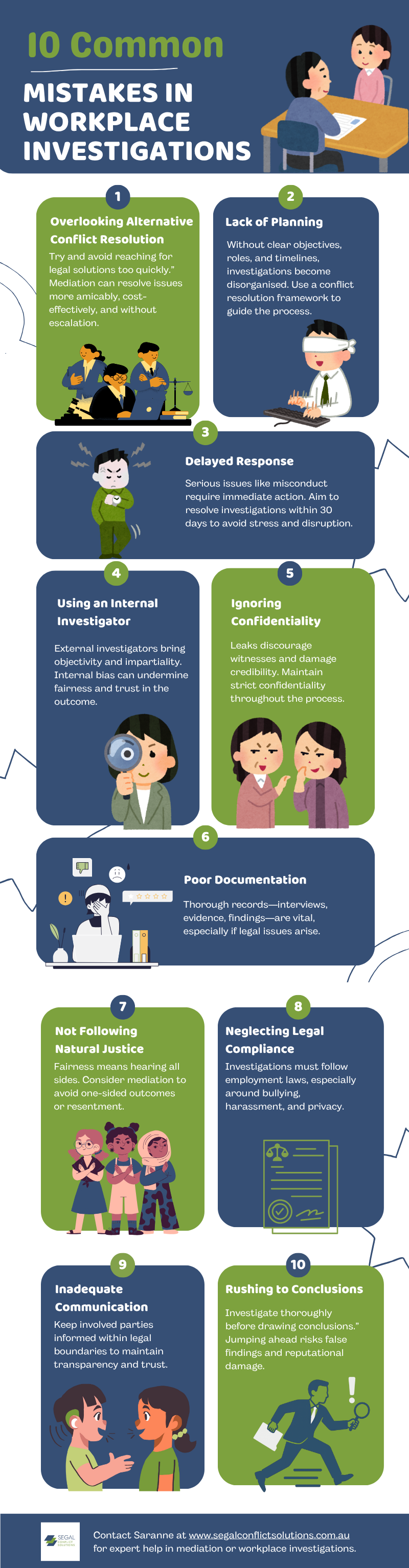
1: Overlooking Alternative Conflict Resolution Methods

Organisations can often do a knee-jerk reaction and start an investigation without considering alternative options for resolving workplace issues. As Melbourne says, “Try and avoid reaching for legal solutions too quickly.” Alternative conflict resolution methods like mediation can often resolve issues more amicably and cost-effectively, preventing unnecessary escalations, strained relationships, and significant costs.

2: Lack of Planning

A well-structured investigation requires careful planning. Without it, confusion and inefficiency can reign. Leaders must establish clear objectives, timelines, and roles for all parties involved. Setting up a conflict resolution framework to create guidelines for addressing issues as they arise and preventing them from festering is essential for any HR department.

3: Having a Delayed Response

Time is of the essence in workplace investigations, especially when it’s serious, such as fraud or sexual misconduct. Procrastinating or delaying an investigation can cause issues to escalate and worsen. Studies also show that some investigations are often not concluded or done unsatisfactorily. We suggest that investigations ideally be concluded within a month, maximum, to prevent undue stress and disruption within the workplace. Learn how to solve complaints within 30 days.

4: Using an Internal Investigator

While using internal resources for investigations can be practical, it can also introduce bias or conflicts of interest. Failing to consider external workplace investigators can compromise the investigation’s integrity. Melbourne emphasises the need for impartiality and objectivity, stating that “external investigators bring objectivity and impartiality to the process, ensuring a fair and unbiased inquiry.”

5: Ignoring Confidentiality

Maintaining confidentiality is paramount during workplace investigations. Breaching the confidentiality of involved parties can discourage witnesses from coming forward and compromise the process’s integrity. Strict confidentiality must be maintained to protect all parties and the investigation’s credibility.

6: Poor Documentation

Inadequate documentation of the investigation process is a critical error. Comprehensive documentation ensures that thorough and organised records are maintained, including interviews, evidence, and findings. This documentation becomes crucial if legal issues arise.

7: Not Adhering to Natural Justice/Procedural Fairness

Failing to follow the principles of natural justice, such as allowing the parties to be heard and providing a fair and unbiased process, can undermine the legitimacy of the investigation. Consider alternatives to investigations, such as facilitation or mediation, to avoid situations where one person feels aggrieved while the other feels righteous. 

8: Neglecting Legal Compliance

Not adhering to employment laws and regulations can result in legal liabilities. Ensure investigations are conducted in compliance with applicable laws, particularly when allegations involve issues like bullying, harassment, or privacy violations.

9: Inadequate Communication

Failing to communicate the progress and outcomes of the investigation to involved parties can lead to confusion, frustration, and distrust among employees. Keeping all stakeholders informed about the process and outcomes within legal constraints is essential for maintaining transparency and trust.

10: Rushing to Conclusions

Jumping to conclusions without gathering all relevant evidence can result in incorrect findings and damage innocent parties’ reputations. Melbourne emphasises the need to “investigate thoroughly before drawing conclusions” to avoid misjudgments and their adverse consequences.

While workplace investigations are necessary in certain situations, avoiding these common mistakes can help organisations navigate the process more effectively and achieve a satisfactory outcome for all parties involved.

Contact me today if you need mediation, facilitation or an external workplace investigator who will handle your situation with care, compassion and impartiality. Call 02 8036 5558 or email: saranne@segalconflictsolutions.com.au

The terms Red Zone and Green Zone were coined by James W. Tamm and Ronald J. Luyet in their book Radical Collaboration.

Collaboration is at the foundation of conflict resolution. When two people are aligned in their desire to collaborate, resolving issues is so much easier – in fact, it doesn’t feel like conflict. 

Red Zone explained

When we approach conflict from the red zone, it means we’re coming from a place of self-interest. We’re defensive. We want to win the argument. If you know the phrase “It’s my way or the highway”, then you’ll know what the red zone feels like.

Bottom line, it’s very hard to get things done when we’re in the red zone (which we all will be at some point). Even if things do go our way, it’s likely to cause resentment and bad feelings from the other party. So a win doesn’t necessarily feel like a win anyway.

Green Zone explained

When we approach conflict from the green zone, it means we’re coming from a place seeking to understand. We’re driven to find creative resolutions so everyone feels like they’ve had a win

Bottom line, getting things done when we’re in the green zone is much easier. By collaborating and cooperating, everyone can come out ahead, resulting in a happier, united environment. 

Picture the scenario:

Michael wants to implement a new process that helps speed up customer deliveries. However, it requires Sam to complete additional tasks. Sam says their workload is already at maximum capacity. 

Red Zone Approach

Michael says they aren’t concerned about Sam’s capacity, they’ll simply need to find a way to get the additional tasks done.

Sam, point blank refuses to take on extra work.

The result is increased tensions in the workplace, resentful feelings from both parties, and the end customer not benefiting from faster deliveries.

Green Zone Approach

Sam recognises that this new process will benefit the customer, so approaches Michael to discuss how they can make it work. 

Michael realises this is additional work for Sam, and together they discuss what tasks Sam can delegate in order to implement the new process. 

The result is Michael helps Sam find someone to take over some of their current tasks, freeing them up to do the tasks associated with the new process. 

Michael is happy because the deliveries are faster, which increases customer satisfaction, and Sam is happy because their workload has not increased.

How to move from the red zone to the green zone

Being in the red zone is part of the human condition. The more we practice being in the green zone, the easier it becomes, but in all of it, self-awareness is key.

Next time you’re faced with potential conflict and feel yourself getting stressed, angry or defensive, try these things.

  1. Stop: Take 5 minutes to walk away from the scenario, slow down and cool off. 
  2. Recognise: What you’re feeling, accept your reaction and allow it to pass.
  3. Reflect: On what you’re feeling and if there are any underlying issues. 
  4. Reset: Think about how you can restart the conversation in a more collaborative way.

My workshop, How to Manage Difficult Conversations and Communicate Better, helps people better understand their red and green zones and provide strategies and skills that help them feel equipped to manage conflicts that arise.

Don’t just take my word for it. Here are a few quotes from participants of a workshop I ran last month.

“I will implement many of these solutions into work and daily life”. 

“I will definitely use the new skills acquired today”.

“Role plays were very valuable.”

Contact me today if this sounds like something your workplace could benefit from. Call 02 8036 5558 or email: saranne@segalconflictsolutions.com.au
Manager criticising an employee

Introduction

Workplace deviance refers to negative behaviours that deviate from organisational norms and can harm employee morale and productivity. This article will explore workplace deviance, its occurrences, and effective strategies to prevent and resolve such behaviour, including mediation, investigation, and conflict coaching.

Understanding Workplace Deviance

Workplace deviance refers to a broad spectrum of employee behaviours that go against established organisational norms, rules, and ethical standards. These behaviours can take various forms and have detrimental effects on both individuals and the organisation’s overall functioning. Some common examples of workplace deviance include:

  • Bullying: Workplace bullying involves repeated mistreatment, harassment, or intimidation targeted at individuals or groups. It can manifest as verbal abuse, spreading rumours, humiliation, or exclusion. Bullying creates a hostile work environment, leading to increased stress, decreased job satisfaction, and higher turnover rates.
  • Tardiness and Excessive Absenteeism: Consistently arriving late to work or frequently being absent without valid reasons disrupts work schedules, hampers team coordination, and affects productivity. It can create a negative work environment and place an additional burden on other employees.
  • Theft: Engaging in theft, such as stealing office supplies, equipment, or company resources, not only results in financial losses but also erodes trust among colleagues. It undermines the organisational culture and fosters an environment of suspicion.
  • Sabotage: Deliberately damaging or sabotaging work processes, projects, or equipment is a form of workplace deviance that can cause significant disruptions and financial losses. In addition, it negatively impacts productivity, morale, and the organisation’s reputation.
  • Spreading Rumours: Spreading false or malicious information about colleagues or the organisation undermines trust, fosters a culture of gossip, and damages professional relationships. In addition, it can lead to misunderstandings, conflicts, and a toxic work environment.
  • Abusive Supervision: Abusive supervision refers to managers or supervisors who engage in hostile, demeaning, or disrespectful behaviour towards their subordinates. This form of deviant behaviour negatively affects employee well-being, job satisfaction, and commitment to the organisation.

Research indicates that workplace deviance is often influenced by various factors such as job dissatisfaction, lack of commitment, low levels of perceived organisational support, and a negative work climate[i]. Additionally, abusive supervision is a significant predictor of deviant behaviour among employees. [ii]

Preventing Workplace Deviance

As business owners and managers, it is essential to proactively address workplace deviance and create a work environment that discourages such behaviour. Here are two preventive measures that can be implemented:

  1. Establish a culture of respect and open communication which is fundamental in preventing workplace deviance. Encourage employees to voice their concerns and provide feedback without fear of retaliation. Foster an inclusive and supportive work environment where employees feel valued, and their contributions are acknowledged. This can be achieved through regular team-building activities, conflict resolution training, and transparent communication channels.
  2. Implement Clear Policies and Consequences: Clearly define and communicate organisational policies regarding expected behaviour, code of conduct, and consequences for deviant actions. Ensure that these policies are readily accessible to all employees and regularly reinforced through training programs and orientations. Consistently enforce the policies to demonstrate that deviant behaviour will not be tolerated and that there are repercussions for such actions.

Resolving Workplace Deviance

In addition to the preventive measures discussed earlier, integrating mediation, investigation, and conflict coaching can significantly contribute to resolving conflicts and preventing deviant behaviour.

  1. Mediation: Mediation facilitates constructive communication between conflicting parties, preserving relationships and empowering employees. It is cost-effective and allows for quicker resolution compared to formal processes.
  2. Investigations: Thorough investigations provide unbiased fact-finding and promote compliance and accountability. They demonstrate a commitment to addressing workplace deviance and rebuilding employee confidence.
  3. Conflict Coaching: Conflict coaching enhances self-awareness, builds conflict resolution skills, and promotes sustainable resolutions. It equips employees with tools for effective communication and reduces the likelihood of recurring deviant behaviour.

Conclusion

Organisations can effectively prevent and resolve workplace deviance by integrating mediation, investigation, and conflict coaching. Establishing a culture of respect, implementing clear policies, and providing training in conflict resolution are crucial steps. In addition, mediation preserves relationships; investigations ensure fact-based decision-making and conflict coaching empowers employees for long-term conflict resolution. By investing in these strategies, businesses can foster a positive and harmonious work environment, minimising workplace deviance and promoting employee satisfaction and success.

References:

[i] Tepper, B. J. (2000). Consequences of abusive supervision. Academy of Management Journal, 43(2), 178-190.

[ii] Wu, L. Z., & Kwan, H. K. (2018). The effects of job insecurity on workplace deviance: The moderating role of ethical leadership. Journal of Business Ethics, 149(2), 441-452.

Conflict is an undeniable reality when people spend their days together in the workplace. It can arise between colleagues, permeate entire teams or emerge between managers and their employees. However, the challenges posed by workplace conflict can be overcome. In this blog post, we will delve into the intricacies of workplace conflict, uncover its root causes, highlight the potential costs it incurs, and provide valuable tips from a seasoned mediator on how

Types of Workplace Conflict:

Workplace conflicts can manifest in different ways, including:

  • Interpersonal Conflict occurs when individuals have personal differences, clash in personalities, or experience a breakdown in communication.
  • Task Conflict: Task-related conflicts arise from work-related goals, processes, or responsibilities disagreements.
  • Leadership Conflict: Conflict may arise when managers and employees have conflicting expectations, communication breakdowns, or differences in leadership styles.
  • Organisational Conflict: Conflicts stemming from structural issues, competing interests, or organisational changes fall under this category.

What Causes Conflict at Work?

Several factors contribute to workplace conflict:

  • Communication Issues: Poor communication, misunderstandings, or misinterpretations can lead to conflicts.
  • Differences in Values and Perspectives: Conflicting individual values, beliefs, or perspectives can spark disagreements.
  • Role Ambiguity: Unclear roles, responsibilities, or expectations can cause conflicts within teams or between managers and employees.
  • Scarce Resources: Conflicts can arise when there is competition for limited resources, such as budget, time, or personnel.

The Cost of Conflict in the Workplace

Unresolved workplace conflict can have significant consequences:

  • Decreased Productivity: Conflicts can disrupt workflow, reduce collaboration, and hamper overall productivity.
  • Increased Stress and Burnout: Employees involved in conflicts often experience heightened stress levels, leading to decreased job satisfaction and increased burnout.
  • Employee Turnover: Persistent conflicts may result in talented employees leaving the organisation, leading to increased recruitment and training costs.
  • Hostile Work Environment: Unresolved conflicts create a toxic work atmosphere, affecting team morale and overall job satisfaction.

Tips for dealing with conflict:

1. Deal with it early:

Don’t avoid it or pretend nothing has happened. Often you will find managers completely shy away from situations with even a whiff of conflict, hoping that the conflict will somehow go away or resolve itself. Unfortunately, as time goes on, the conflict only will escalate. Deal with these uncomfortable issues as soon as possible.

As a workplace mediator, it is common to be brought into the dispute when it has blown up, and it is at the stage where the employee threatens to walk or litigate. Our advice is that if you notice a conflict between employees, get them to sort it out sooner rather than later and encourage them to find a way to work it out directly with each other.

We often see that a manager has tried to mediate multiple points of view, wearing the mediator’s cap with no solvable outcome. Sometimes despite a manager’s good intentions, it is necessary to bring in professional mediators because it certainly is not easy trying to navigate across multiple types of personalities where each person is coming from a different place, especially if this is outside the manager’s specific area of expertise.

2. Communication is key: 

As a mediator who frequently handles workplace disputes, I have witnessed firsthand the pivotal role that communication plays in achieving positive conflict resolution. To initiate meaningful dialogue, it is crucial to acknowledge the existence of the conflict. When individuals come together to address the issue, each person should be given ample time to express their perspective on the situation.

Equally important is the clear definition and understanding of the needs of all parties involved. Finally, it is essential to remember that this is not the time to engage in attacks or assign blame. By fostering open and constructive communication, the path towards resolution becomes clearer.

3. Listen carefully:

In my experience, listening with empathy to the other person’s needs, thoughts, and beliefs can work miracles. Sometimes a person just needs to be heard to feel valued, and often, this opportunity is not given to them. To actively listen to someone means putting yourself in the other person’s shoes and then paraphrasing what they say to ensure you have understood correctly. This is a challenging thing to do, especially when you have strong divergent viewpoints.

It is, however, worth the effort because when people feel understood, their need to hold onto their position in the conflict can dissipate, and a path toward understanding and agreement can be paved.

4. Find agreement: 

During the process of resolving conflicts, your conversations will naturally centre around the issues at hand. We commonly feel a strong urge to prove that we are right and the other person is wrong—a win/lose mentality. However, it’s essential to recognise that a genuine resolution often arises when both parties find common ground. Rather than focusing solely on differences, take the opportunity to discuss shared interests and values.

By actively looking for these commonalities, you can foster understanding and empathy. It’s valuable to share examples where you genuinely see the other person’s point of view. This approach promotes agreement and demonstrates a genuine willingness to rebuild the relationship on a foundation of shared understanding and cooperation.

5. It may be time to engage an impartial mediator: 

If these strategies are not working, it may be necessary to bring in an impartial mediator to try to restore the working relationship between the conflicting parties. Using a mediator with no allegiance to the organisation means employees are more likely to trust the process and be more willing to engage in the discussions to work towards positive outcomes in the organisation’s best interests.

The mediator’s role is to help the parties identify the issues and the core problems surrounding the dispute, and step by step, with the mediator’s help, they explore options and work towards a resolution that benefits both parties as well as the organisation.

Conclusion: 

Organisations must promptly and effectively address workplace conflict as it poses a significant challenge. By implementing the tips provided in this blog—dealing with conflicts early, prioritising communication, actively listening, finding common ground, and seeking professional mediation—companies can foster a positive work environment and nurture healthy relationships among team members. In addition, conflict resolution requires understanding, patience, and a genuine desire to find mutually beneficial resolutions.

To truly promote a collaborative and thriving workplace, it is essential for individuals to approach workplace conflict proactively. Embrace open dialogue, acknowledge the existence of conflicts, and work towards resolutions that benefit all parties involved. By investing in conflict resolution strategies, organisations can minimise the negative impact of conflicts, enhance productivity, boost employee satisfaction, and achieve overall success.

Remember, the next time you encounter workplace conflict, be proactive in addressing it, facilitate open communication, and actively seek resolutions that benefit everyone. We can create a harmonious work environment where conflicts are constructively addressed, paving the way for a more collaborative and thriving workplace.

The Art of Win-Win Orientation

Conflict is an inevitable part of our lives, and the way we handle it can have a significant impact on our relationships, both personal and professional. Negotiation, in particular, plays a crucial role in resolving conflicts and reaching mutually beneficial agreements. But what happens when the win-win orientation is absent?

In this article, we’ll explore the fascinating dynamics of conflict resolution to understand the importance of embracing win-win negotiation.

The Absence of Win-Win Orientation:

Picture this: two colleagues, Tom and Alice, engaged in a fierce disagreement over a project deadline. Both are determined to defend their positions, their egos getting the better of them. Unfortunately, the win-lose mentality takes centre stage, and the situation quickly escalates into a heated confrontation.

Different Responses to Conflict:

When a win-win orientation is absent, negotiations can quickly devolve into a competitive and adversarial atmosphere. Parties involved may prioritise their individual interests and focus on “winning” the negotiation, often at the expense of the other party. This shift in approach gives rise to various responses to conflict.

Let’s take a closer look at some of these responses:

The “Bulldozer” Approach:

In this scenario, one party bulldozes their way through, completely disregarding the other’s concerns and needs. It’s like trying to resolve a conflict with a wrecking ball! Needless to say, this approach rarely leads to a satisfactory outcome and will most likely damage relationships along the way. Tom and Alice certainly don’t want to be known as the office wrecking balls!

The “Avoidance” Tactic:

The classic “ostrich in the sand” approach. When faced with conflict, some people prefer to bury their heads and pretend it doesn’t exist. Unfortunately, the problem doesn’t magically disappear, and tensions continue to simmer beneath the surface. In our case study, if Tom and Alice choose to avoid addressing the project deadline issue, it’s only a matter of time before the volcano will erupt.

The “Compromise Trap”:

Imagine a seesaw with two people, each pushing with all their might to gain an advantage. Compromise often feels like a fair solution, but it can leave both parties feeling unsatisfied like they’re riding a seesaw stuck in the middle. Tom and Alice might end up compromising on the project deadline, but neither will be truly happy with the outcome, leading to potential resentment and diminished productivity.

The Case Study: Tom and Alice’s Journey to a Win-Win Resolution:

Now, let’s turn our attention to Tom and Alice again. They have a choice: to continue down the path of destructive conflict or embrace the win-win approach. Recognising the need for a more constructive approach, they decide to tap into their unique strengths to navigate the conflict and find a win-win solution.

In the midst of their heated disagreement over the project deadline, Tom and Alice find themselves at a crossroads. Tom, known for his love of puzzles, suggests bringing in a whiteboard and markers to visually map out their conflicting needs.

With his analytical mindset, he understands that visualising the problem can help break it down into manageable components. As they start drawing on the whiteboard, Tom  and Alice begin to see the different layers of the issue and gain a clearer understanding of each other’s perspectives.

While Tom’s puzzle-solving approach helps shed light on the complexity of the conflict, Alice, with her talent for finding common ground, steps in with her empathetic and diplomatic nature. She suggests exploring a compromise that incorporates elements from both Tom and Alice’s viewpoints.

Drawing on her ability to listen attentively and understand the underlying motivations of each party, Alice proposes a solution that not only addresses their individual needs but also allows for collaboration and synergy. Tom realises that Alice’s suggestion aligns with his desire for a win-win outcome, and they decide to further refine the proposed solution. They engage in open and respectful communication, actively listening to each other’s concerns and exploring alternatives.

Through their collaborative efforts, Tom and Alice begin to see the potential for a win-win resolution. They brainstorm innovative ideas that combine their strengths and leverage their shared goals. With a focus on cooperation rather than competition, they find creative ways to meet the project deadline while also ensuring quality and maintaining a positive working relationship.

As they finalise their agreement, Tom and Alice experience a sense of satisfaction and accomplishment. They realise that by embracing the win-win orientation in negotiation, they not only resolved the conflict but also strengthened their bond as colleagues.

Embracing the Win-Win Orientation

Tom and Alice’s journey illustrates the power of embracing a win-win orientation in negotiation and conflict resolution. By prioritising cooperation, active listening, and empathy, they were able to transform a potentially destructive conflict into a mutually beneficial outcome.

In the end, Tom and Alice reach a win-win resolution that goes beyond their initial expectations. They not only meet the project deadline but also implement improvements that enhance the overall quality of their work. Their collaborative effort and commitment to understanding each other’s perspectives strengthen their professional relationship and create a positive work environment.

Here are a few key takeaways for incorporating win-win negotiation strategies:

  1. Focus on Interests, Not Positions: Instead of stubbornly defending positions, explore the underlying interests and needs of all parties involved. By understanding the motivations behind each perspective, you can find creative solutions that address everyone’s concerns.
  2. Collaborate and Brainstorm: Create an environment that encourages collaboration and idea generation. By leveraging the collective intelligence and diverse perspectives of all stakeholders, you can uncover innovative solutions that may not have been apparent initially.
  3. Practice Active Listening: Truly listening to each other promotes understanding and helps build trust. By actively engaging in the conversation, seeking clarification, and reflecting on what has been shared, you can demonstrate empathy and foster a productive dialogue.
  4. Maintain a Win-Win Mindset: Adopting a win-win mindset means believing that there are solutions that can benefit all parties involved. Approach negotiations with a cooperative attitude and a focus on mutual gains rather than seeking to “win” at the expense of others.

Conclusion

Remember, when the win-win orientation is present, conflict transforms into catalysts for positive change. It’s not about seeking victory at the expense of others but finding solutions that satisfy everyone involved. So, let’s ditch the bulldozers, pull our heads out of the sand, and resist the allure of compromise traps. Instead, let’s approach conflict with open minds, empathetic hearts, and a commitment to finding mutually beneficial outcomes.

In the spirit of win-win negotiation, let’s strive for harmony, collaboration, and productive resolutions. As we embrace this mindset, we’ll not only create a more harmonious work environment but also foster stronger relationships, boost creativity, and unlock the full potential of our teams.

So, the next time you encounter a conflict, remember the power of win-win negotiation. Embrace the opportunity to transform differences into strengths and conflicts into opportunities for growth. Together, we can create a world where cooperation triumphs and conflicts are resolved with laughter, understanding, and a shared sense of purpose.

Let’s embark on this journey of win-win negotiation and watch as conflicts dissolve, replaced by newfound understanding and thriving relationships.

What does the word productivity conjure up for you? Manual labour, physical output or efficiency? Pre-pandemic, it was easier to measure productivity (inaccurately) based on the time an employee spent at their desk.

With most office-based employees working at least some time at home, many workplaces struggle with ‘productivity paranoia.’ This is despite numerous surveys showing hybrid workers sleep and exercise longer, dedicate more time to establish healthy eating habits, and report spending more time on their health and well-being.[1]

One solution workplaces are leveraging is the use of surveillance tools and software. While more common in the US – with a reported 96% of fully remote companies using it[2], Australia is not exempt.  Recently, CBA was scrutinised for harvesting information such as physical attendance and computer data. It used this to force workers to apply for leave if their activity suggests they aren’t productive enough.[3]

Some shocking statistics from the US survey found monitoring methods used by employers including:

  • Monitoring web browsing and app use (62%)
  • Blocking content and apps (48%)
  • Tracking attention via biometrics (45%)
  • Capturing random screenshots (43%)
  • Logging keystrokes (37%)

But are these forms of micro-management and acute observation really optimising employees’ work time and improving their productivity? Is understanding how busy someone appears to be helpful? Or are organisations better off focusing on the goals and objectives being met (or not)? 

I recently interviewed author, entrepreneur and thought leader Seth Godin; this was one of the topics we touched on. He believes organisations focusing on individual growth and impact instead of taking attendance, long Zoom calls, and having cameras over desks are more successful in leading distributed workforces. “Obedience isn’t the point when we talk about our passion. Obedience is the mindset of school, a test of compliance. But that’s not what employers are paying people for. You are paying them to make a change happen.”

This change Seth refers to provides employees with significance – or purpose, in their jobs. It’s the feeling of achievement, of impact, and it doesn’t have to be large-scale. Just making a difference to your team or a few customers is enough. 

This is backed up by other studies, like this one from Gartner, that suggests that employees want a shared purpose and are looking for their employers to deliver concrete action on purpose, not just through corporate statements.

Organisations need to do more than talk. They must deliver on their mission and vision and think carefully and strategically about the employee experience. The need to view your workforce as individuals, as people you care about, can be the difference between developing a company that thrives or survives.

Fostering a workplace environment that focuses on individual purpose, growth, and impact towards shared goals drives productivity in itself. Organisations that do this will be ahead of the curve, reduce workplace conflict and attract and retain the best talent in the market.

Contact me today if you need help establishing a culture that’s fit for purpose. Call 02 8036 5558 or email: saranne@segalconflictsolutions.com.au

 

You’ve heard the saying. “People don’t leave bad jobs (or companies). They leave bad managers.”

If you’ve been in the workforce long enough, you’ve probably experienced a bad manager. A recent poll found more than two in five of us have left a job because of a bad manager. In the past, having a bad manager could’ve just been viewed as one of those things. But in today’s environment, having bad managers comes at a high cost to your business and the health of your employees.

This article explores these and what organisations can do to prevent bad managers.

What are the traits of a bad manager?

In the same poll, respondents listed the following:

  • Failure to listen
  • Being unapproachable
  • Treating members of the team differently
  • Shouting at the team.

Each of these could be treated as a minor annoyance if taken as a one-off incident. But imagine if these are consistent daily behaviours. It wouldn’t take long for a toxic culture to spread through the team, becoming a serious issue.

The costs of a bad boss

Cost to business

When an employee leaves, usually, they must be replaced. The cost of finding a new staff member has increased by $10k over the previous year and now sits at an average of $23,000 per candidate.

It’s not just the sole recruitment cost. Often there is an upward salary creep and additional benefits offered to attract new employees. Sign-on bonuses are also increasingly prevalent in a tight talent market.

Consider, too, the lost productivity of an existing team.
Burnout, stress and dropping the ball are caused by covering vacant roles alongside their own.
Hiring managers time to read and screen resumes, interview candidates or check references.
Onboarding and training of the successful candidate.

Throw in the loss of institutional knowledge, skills, experience, customer relationships and intellectual property when employees depart, and it’s clear losing a good staff member is something businesses should avoid.

Risk of reputation

Companies go to great lengths to protect their reputation, but with sites that allow employees to rate their experiences, it’s much harder to hide dodgy behaviour. If they have one or two bad managers, maybe their reputation can stay unblemished. But multiple bad managers will see the entire organisation tarred with the toxic culture brush. Meaning they will struggle to attract talent and even customers.

Risk of complaints and claims

Psychosocial hazards are a work health and safety matter, which means a person conducting a business or undertaking must eliminate psychosocial risks or, if that is not reasonably practicable, minimise them so far as is reasonably practicable.

Bad boss behaviours, such as bullying, harassment, constant criticism, discrimination, and violence, harm employees’ mental and physical well-being but also have significant financial consequences. It is estimated that workplace bullying costs Australian businesses around $6 billion annually. And mental health conditions have risen from 6.2% of all serious claims in 2014-15 to 9.3% in 2020-21.

https://www.safeworkaustralia.go

v.au/doc/key-work-health-and-safety-statistics-australia-2022

The largest share of mental health conditions related to anxiety or stress disorders (36%) or reaction to stressors – other, multiple or not specified (34%). It’s not just mental health that can suffer – bad management is proven to be hazardous to your physical health too.

Bad bosses contribute to heart attacks

A 10-year study concluded that employees with a toxic boss are 60% more likely to suffer a heart attack or other life-threatening cardiac condition.

Continual exposure to these four manager behaviours was shown to contribute to serious health issues:

  • Incompetence.
  • Inconsiderate.
  • Secretive.
  • Uncommunicative.

What organisations can do to prevent bad bosses

It is common for someone to be promoted to a management position because they have the most experience or institutional knowledge. However, in my experience, this often holds more weight than it should because people management is the most significant component of being a boss. The difference between a team thriving or surviving is how effective you are at this.

Conflict resolution training equips managers with a toolkit that helps them utilise EQ skills to connect and collaborate, especially in tough situations.

The power of in-person workshops is such that it only takes a few hours for people to come away enlightened and confident they can:

  • Engage with other colleagues to help them tackle difficult conversations.
  • Extinguish, identify and manage potential conflicts before they become disputes.
  • Deliver performance feedback without the fear of bullying accusations.
  • Communicate effectively.

Contact me today if you need help with a bad boss (or two). Call 02 8036 5558 or email: saranne@segalconflictsolutions.com.au